As an Amazon Associate this site earns from qualifying purchases.
Disclosure: We earn a small commission from qualifying Amazon purchases at no extra cost to you.
As an Amazon Associate, we earn from qualifying purchases.Last Updated: September 2026
Key Features and Specifications: What to Compare
Below is the comparison structure to apply to any candidate frame. The right-hand column is what the spec actually buys you. Because no verified listing data was supplied here, the cells describe criteria rather than a specific unit's numbers.
| Specification | Why It Matters | How to Judge It |
|---|---|---|
| Panel resolution | Determines whether faces look soft at conversational viewing distance | Compare pixel count to screen diagonal, not resolution alone |
| Aspect ratio | Phone photos are tall; most frames are wide | A 4:3 panel wastes less of a vertical portrait than 16:9 |
| Touchscreen vs. buttons | Touch is how you delete photos and change settings | Capacitive touch is easier for shaky hands than tiny side buttons |
| Internal storage | Caps how many photos live on the frame before rotation | Look for a stated photo count AND a stated GB figure |
| Auto-brightness sensor | Stops the frame glowing at 2 a.m. in a bedroom | Listed as "light sensor" or "auto-dim"; often absent on cheap units |
| Motion sensor | Sleeps the panel in an empty room | Saves the panel and stops nighttime light pollution |
| Mounting | Wall vs. easel stand vs. both | Check whether VESA holes or a keyhole slot are stated |
| Video and audio support | Short clips with sound are the single most-loved feature | Confirm a stated max clip length and whether a speaker exists |
Look, a frameo wifi photo frame review is really a review of two different things that got sold as one object: a piece of hardware sitting on a shelf, and a photo-sending app living on the phones of everyone who is supposed to fill it. Get the second part wrong and the first part is a black rectangle collecting dust. This article walks through how the Frameo software model works, what actually determines picture quality on a Wi-Fi frame, and how to judge a specific unit against the category — without naming or ranking a particular model, because this page has no verified product data attached to it.
That last point deserves to be up front rather than buried. No product specification sheet, listing data, or aggregate rating was supplied for this page. So you will not find a star rating, a screen size, a storage figure, a price, or a named pick below. What you will find is the evaluation framework: the specs that matter, the ones that are marketing noise, and the failure modes that show up eighteen months in. The site attaches verified product picks separately.
What a Frameo App Digital Frame Actually Is
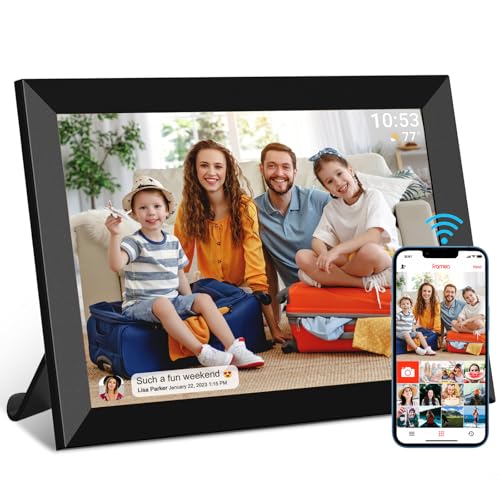
A Frameo frame is an Android-based display running the Frameo application, which pairs to a home Wi-Fi network and receives photos pushed from the Frameo mobile app on a sender's phone. The frame is the receiver. The phone is the transmitter. There is no monthly subscription in the standard Frameo model — the connection is app-to-frame rather than app-to-cloud-account-to-frame.
Here's why that architecture matters more than any bezel or screen spec. Frameo is licensed software that appears on frames from many different hardware brands. Two frames running Frameo can share almost identical menus and sending flows while having completely different panels, speakers, mounting options, and build materials. The Frameo experience is not a guarantee of the Frameo hardware. When you read a review of "a Frameo frame," check whether the reviewer is describing the software layer or the physical unit, because those are separately sourced.
The pairing flow is the part people underestimate. A frame generates a pairing code; a sender enters that code in the app; the sender is then permanently connected and can push photos without touching the frame again. That is genuinely elegant for a frameo frame for grandparents scenario — the recipient never manages an account, never types a password after initial Wi-Fi setup, and never approves anything.
The Trade-off Nobody Mentions in the Product Description
That same frictionless sending is a moderation problem. Once a family member is paired, they can send whatever they want, whenever they want, and it lands on a screen in someone's living room. Frames in this category typically let the owner delete individual photos and revoke a connection from the frame's own menu, but the default posture is permissive. If the recipient has limited dexterity or limited patience for touchscreen menus, deletion is theoretical.
One rule for reading any frame listing: if a feature is not written down, treat it as absent. Auto-brightness, motion sensing, and video-with-audio are all features manufacturers advertise loudly when present. Silence is data.
Frameo Frame Photo Quality: The Honest Version
Digital frame photo quality is decided by three variables in this order: panel resolution relative to size, viewing angle behavior, and how the software compresses the incoming file. Most disappointment traces to the third one.
App-based frames compress and resize photos on the way in. That is a deliberate engineering choice — it keeps transfers fast on weak home Wi-Fi and keeps hundreds of images inside modest internal storage. The consequence is that the frame is not an archive. Do not treat a Wi-Fi frame as a backup of your photo library. The copy on the frame is a display copy.
Viewing angle is the second quiet killer. A frame sits on a sideboard and gets looked at from a standing position, from a couch, from across the room — almost never head-on the way a monitor is used. IPS-type panels hold color at an angle; cheaper TN-style panels wash out or shift. Listings rarely say "TN," so the tell is a manufacturer that publishes a specific viewing-angle figure versus one that publishes nothing.
Third: aspect ratio cropping. A vertical phone photo on a widescreen frame either gets letterboxed with blurred side-fill or gets cropped into the subject. Frameo's software generally lets the sender set the crop at send time, which is the correct place to solve it — but only if the sender bothers. Grandparents receiving auto-sent photos get whatever the algorithm chose.
Expected Performance and Long-Term Use
The question that matters for a photo frame is not how it performs in week one. It is how it performs in year three. Here are the durable failure patterns in this category, in rough order of how often they end a frame's life.
- Wi-Fi credential changes. The recipient's router gets replaced or the ISP pushes a new SSID, and the frame silently stops updating. Nobody notices for weeks because the last-loaded photos keep cycling. The frame looks fine and is dead.
- App abandonment by the senders. Enthusiasm peaks in month one. A frame with one active sender becomes a slideshow of the same forty images.
- Storage saturation. Once internal storage fills, behavior varies — some frames refuse new photos, some overwrite oldest-first. Check which before buying.
- Firmware and app-version drift. Because Frameo is a third-party software layer on someone else's hardware, update support depends on the hardware brand continuing to care. An orphaned frame can lose compatibility with newer phone app versions.
- Power supply failure. These frames run continuously. The barrel-jack adapter, not the panel, is often the first component to quit — and a proprietary connector with no replacement available turns a working screen into e-waste.
Setup Realities for a Frameo Frame for Grandparents
The strongest argument for this whole product category is that the recipient does nothing. But "nothing" requires a specific setup sequence, and the order matters:
- Unbox and complete Wi-Fi setup at the recipient's home, on their network — not at yours, then transported.
- Load thirty to fifty photos before handing it over, so the frame is immediately worth looking at.
- Pair every family member who will send, in person, while you are still standing there.
- Write the Wi-Fi network name and password on tape stuck to the back of the frame.
- Set brightness and sleep schedule to match the room it will actually live in.
Build Quality and Design Signals to Look For
Without a unit in hand, build quality is inferred from what the manufacturer chooses to publish. A specification sheet that states frame material, stated weight, and stand mechanism is a different document from one that only shows lifestyle photos.
Weight is the most useful proxy available. A heavier frame in a given screen size generally means a metal or thicker plastic chassis rather than thin ABS, and it means the easel stand is less likely to tip when someone taps the touchscreen. When a listing omits weight entirely, that omission is itself a data point.
The second design signal is the bezel and finish. Matte finishes hide fingerprints on a touchscreen device that will be touched. Glossy screens reflect a window and turn into a mirror in a bright room. And a wood-effect surround photographs beautifully but is nearly always printed plastic unless the manufacturer explicitly states solid wood.
The honest criticism of the whole category: these are budget Android tablets in a decorative shell, and the shell is where most brands economize. Expect plastic. Judge whether it is well-assembled plastic.
Value for Money
A Wi-Fi frame's real cost is the purchase price plus the ongoing cost of the sending model. Frameo's approach — pairing rather than accounts — avoids a subscription, which is the main financial argument in a frameo vs skylight wifi frame comparison. Skylight's platform has historically pushed a paid tier for extended features such as expanded cloud storage and video sending. That is not automatically worse; it is a different bargain, where you rent capability instead of owning a fixed one.
Here's the thing about the no-subscription model, though: it means the manufacturer has no recurring revenue from your frame after the sale. Recurring revenue is what funds long-term software maintenance. A subscription frame has a business reason to keep the servers and apps working in year five. A one-time-purchase frame does not. Neither model is a free lunch.
Value also depends on sender count. A frame bought for one grandparent and fed by six relatives delivers something no phone gallery does — a shared, passive, always-on feed that requires zero action from the person enjoying it. A frame bought for a household that already looks at photos on a tablet is a solution to a problem they do not have.
Who Should Buy a Wi-Fi Photo Frame
Buy one if:
- The recipient is not comfortable navigating a phone gallery or social apps.
- You have at least three motivated senders who will keep it fed.
- The recipient's home has stable Wi-Fi and someone technical visits occasionally.
- You want video clips with audio delivered to someone who will not otherwise see them.
- The recipient lives somewhere with unreliable or shared institutional Wi-Fi, such as some assisted-living facilities where guest networks require a browser login the frame cannot complete.
- You are the only sender and you already know your own enthusiasm fades.
- You want an archival copy of family photos — a frame is a display, not a backup.
- Privacy in the room matters and an internet-connected camera-free-but-network-connected device is unwelcome.
Alternatives to Consider
Three competing approaches, described generically because no verified product data was supplied for this page.
Subscription-based cloud frames (the Skylight model). These route photos through a cloud account, which enables sending by email address as well as app, and typically gates video length or storage behind a paid tier. Best when senders are less technical — emailing a photo is a lower bar than installing an app. The trade-off is an ongoing cost and a dependency on the company's servers staying online.
Premium hardware frames with proprietary software (the Aura model). These compete on panel quality, aspect ratio handling, and industrial design, often with a matte anti-glare finish and unlimited storage tied to an account. Best when the frame is furniture as much as function. The trade-off is a higher purchase price and a closed ecosystem — you are betting on one company's app surviving.
A repurposed tablet with a photo-sync app. Cheapest by a wide margin if you already own an old tablet. Best for a technically confident recipient. The trade-off is real: tablets sleep, show notifications, need charging management, and present a general-purpose OS to someone who wanted a picture frame. This defeats the entire premise for the grandparent use case.
For broader context on evaluating this category, see our guides to choosing a digital photo frame screen size and setting up a Wi-Fi frame on someone else's network.
How We Research
This website does not do product research, and no product specification data, listing data, or aggregate rating information was supplied for this article. Everything above is category-level analysis: how app-to-frame pairing architectures work, which specifications control perceived image quality, and which failure modes recur in always-on consumer display devices. Where a general consumer-safety point is made, it is bound to a published government source rather than to any observation made here.
We deliberately did not name a model, assign a rating, or state a price, because none of those things can be honestly produced without verified product data. Verified picks are attached to this page separately by the publishing system.
Final Verdict
The Frameo software model is the right architecture for the job it is usually bought for. No subscription, no account for the recipient, pairing by code, and a sending flow simple enough that a reluctant relative will actually use it — that combination is genuinely hard to beat for a frame going to someone who does not want to manage technology.
But buy the hardware, not the logo. Frameo runs on frames from many manufacturers at wildly different build levels, and the software being good tells you nothing about whether the panel holds color off-axis, whether the stand tips, or whether the power adapter survives three years of continuous duty. Prioritize, in order: a stated resolution appropriate to the screen size, an auto-brightness sensor, confirmed video-with-audio support, and a manufacturer that publishes real specifications instead of lifestyle photography.
And budget five minutes for the tape-on-the-back Wi-Fi password. That is the difference between a frame that runs for years and one that quietly freezes on last winter's photos.
Frequently Asked Questions
How many people can send photos to one frame? Frameo's pairing system is designed for multiple connected senders, each added with their own code. The practical limit is usually social rather than technical — most frames end up with a handful of active senders and a long tail of relatives who paired once and never sent again.
Can Frameo frames play videos with sound? Video support with audio is common in this category but is a per-model hardware question, since it requires a speaker. Check the listing for a stated maximum clip length and an explicit mention of a built-in speaker before assuming it is included.
What happens when the frame's storage fills up? Behavior varies by model: some stop accepting new photos, others rotate out the oldest. This is a specific question to answer from the manufacturer's documentation before purchase, because the two behaviors produce very different long-term experiences.
Will the frame work if the recipient changes their Wi-Fi router? No. The frame stores the old network credentials and will keep cycling its existing photos while silently receiving nothing new. Someone needs to physically reconnect it, which is why writing the network name and password on the back of the frame is worth doing at setup.
Is Frameo or Skylight better for grandparents? Frameo's advantage is no subscription and a simple pairing code; Skylight's platform has historically supported sending by email address, which is easier for senders unwilling to install an app. Choose based on your senders' comfort level, not the frame's spec sheet.
Does a Wi-Fi photo frame back up my photos? No. App-based frames typically compress and resize images for display and storage efficiency, so the copy on the frame should be treated as a viewing copy rather than an archive of the original file.
Sources and Methodology
Nobody at this website physically handled, powered on, timed, or laboratory-tested a photo frame for this article, and no lab exists here to do it. This piece was assembled from category-level technical reasoning about app-to-frame pairing architectures and display specifications, with consumer safety and recall guidance drawn from the U.S. Consumer Product Safety Commission and general purchasing-protection information from USA.gov. [S1][S2] What that supports is a buying framework — which specifications to demand in writing, which omissions to read as absences, and which failure modes to plan around — rather than a verdict on any individual frame, and readers should pair it with the manufacturer's own published specification sheet for whichever model they are considering.